
EMERGENCY24/7REPAIR
Automatic sliding doors are ubiquitous in public life, found in hospitals, airports, and retail storefronts. The device that makes those doors open and close safely and reliably is the sliding door operator. This article provides a more in-depth examination of what the operator is, its historical development, the inner workings of the header during each cycle, and the primary variants currently in use.
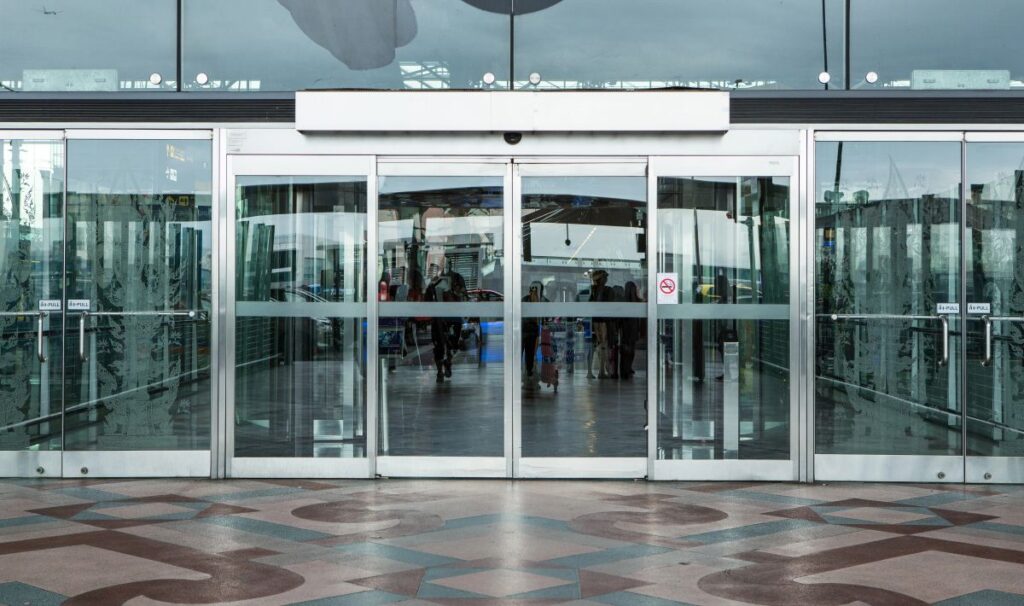
A sliding door operator is an electromechanical system that automates the operation of a pedestrian sliding door. It is positioned in a header above the opening or within the ceiling line and typically consists of a motor and gearbox, a toothed belt or other drive mechanism, a microprocessor controller, door hangers and rollers riding on a track, guides at the floor, and a suite of activation and safety sensors. In the United States, these systems fall under ANSI/BHMA A156.10, the primary safety and performance standard for power-operated pedestrian doors, which encompasses designs such as sliding, swing, and folding doors. It is distinct from UL 325, which addresses operators for vehicular gates and similar systems, not pedestrian entrances.
Devices that open doors without direct human force have been imagined for centuries. Still, the modern era began in the early 1930s when engineers Horace H. Raymond and Sheldon S. Roby of Stanley Works patented an optical, photoelectric apparatus that triggered a door to open. Contemporary documentation and the granted U.S. patent indicate that this system was in use by 1934, with a well-known installation at Wilcox’s Pier Restaurant in West Haven, Connecticut.
In 1954, Dee Horton and Lew Hewitt developed the first practical automatic sliding door after observing that wind loads made swinging doors unreliable on the Texas coast. They later founded Horton Automatics in 1960 to commercialize the product, which helped cement sliding operators as a mainstream entrance technology.
Activation evolved from pressure mats to microwave motion sensors and active infrared presence detection, which improve traffic flow and safety by distinguishing approach from presence at the threshold. Dual-technology heads that combine microwave technology for motion detection and infrared technology for presence detection are now common in sliding entrances.
For pedestrian installations, ANSI/BHMA A156.10 establishes the baseline for activation, safety zones, forces, signage, and other requirements. In Europe, EN 16005 covers safety in use for power-operated pedestrian doorsets, including sliding designs, with system-level requirements for monitored safety sensors and protective fields. Both standards focus on preventing impact, entrapment, and nuisance closures while ensuring reliable traffic flow.
Model building codes also require that a power-operated entrance used for exit serve as a safe egress. For sliding doors, that typically means breakout capability, where the panels and often sidelights can swing out in the direction of escape when pushed, providing a code-compliant clear width. The 2021 IBC addresses power-operated doors in Section 1010.3.2. Industry guidance explains that sliding doors used on egress paths must open to full width when subjected to force from the egress side, which is why breakout or breakaway mechanisms are commonly used on retail and healthcare entries.
In A156.10, a breakaway device permits egress under emergency conditions, and breakout is the act of swinging the panel in the egress direction. These definitions underpin how inspectors and installers assess compliance.
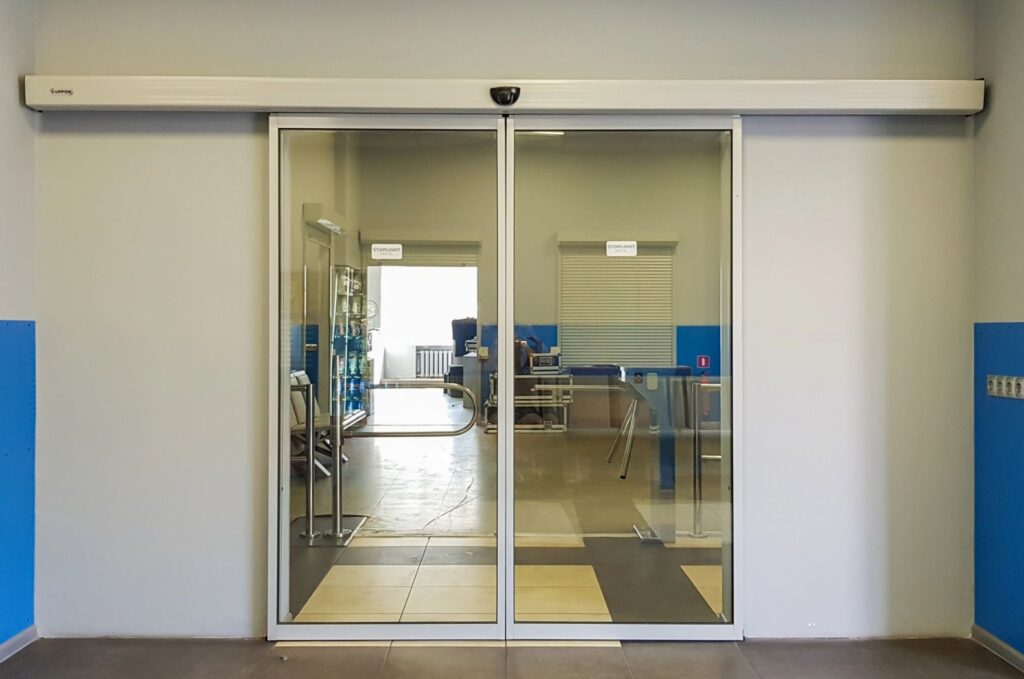
All-glass storefront packages feature suspended tempered or laminated glass, with minimal framing and appropriately rated hardware and rails. The operator logic remains the same, but sensors and protective fields must be tuned carefully, as transparent panels invite closer approach.
Microwave radar detects approach, with adjustable range and direction sensing to reduce false triggers from passing traffic.
Active infrared curtains or light grids monitor the threshold and door path, ensuring the door will not close on a person or object.
Combining microwave and infrared allows the operator to differentiate between approach and presence, maintaining safety if one channel is compromised.
Other common inputs include knowing-act devices, such as push plates or card readers, for controlled areas, and supervised safety beams across the opening. All safety channels should be monitored so that a failed sensor forces the system to a safe state rather than continuing operation.
 Inspection and maintenance
Safety in the field depends on correct specification and ongoing inspection. In the U.S., the industry recommends daily owner checks and annual inspections by an AAADM-certified technician to verify activation zones, presence coverage, closing speeds, decals, and signage conform to the current standard and site use. Many manufacturers embed this guidance directly in owner manuals and labels.
Do not apply UL 325 gate-operator rules to pedestrian sliding doors. UL 325 is written for vehicular gates and related barriers, while pedestrian sliding entrances are governed by A156.10 and building codes.
Transparent or high-sunlight façades often require adjusted infrared sensitivity and additional beams to maintain coverage across the full opening during close-up. Follow the sensor manufacturer’s pattern drawings and perform functional tests after any adjustment.
If a sliding entrance serves egress, plan for partial or complete breakout and verify the clear width and force limits conform to standards and code intent.
A sliding door operator is more than a motor in a header. It is a safety-critical system governed by well-defined standards, tuned by trained technicians, and integrated with sophisticated sensors that balance traffic flow and user protection. Historically, the leap from optical triggers in the 1930s to mat-activated sliding doors in the 1950s set the stage for today’s microprocessor-controlled, sensor-rich operators that serve millions of safe cycles in demanding environments.
If you are specifying, installing, or maintaining a sliding entrance, anchor your decisions in A156.10 or EN 16005. Tune the activation and presence fields to the real-world approach paths and test regularly. That is how these systems deliver the seamless experience people expect when they walk toward a door that seems to open by itself.
Trusted Door & Locksmith Expert in the GTA
30 mins arrival & your satisfaction guaranteed!